Hinge vs Bumble for men: which app actually gets you dates?
Hinge vs Bumble for men in 2026: how matching works, who’s growing, what changed when Bumble dropped women-first messaging, and which one to use first.
By Still GravityPublished 6 min read
The short answer
For most men who want a relationship, start with Hinge. Its prompts reward a well-written profile, and it’s the one growing in 2026. Add Bumble as a second app if it’s busy where you live.
- Hinge: you like or comment on a specific photo or prompt, so effort shows.
- Bumble: since August 2026 either person can message first, which removes its old advantage for men who hate openers.
- Momentum: Hinge revenue up 22% and users up 13% in Q2 2026; Bumble app revenue and paying users both down.
Is Hinge or Bumble better for men?
Hinge, for most men looking for a relationship. It asks you to write, and every like is attached to something specific on her profile, so a man who puts in effort stands out. Bumble is a swipe app with a long history of women-first messaging, which ended in August 2026. It’s now closer to Tinder than to Hinge.
That doesn’t make Bumble useless. If it’s the busy app in your city, it can be the faster route to dates. But if you can only keep one profile in good shape, make it Hinge, then add Bumble once Hinge is working.
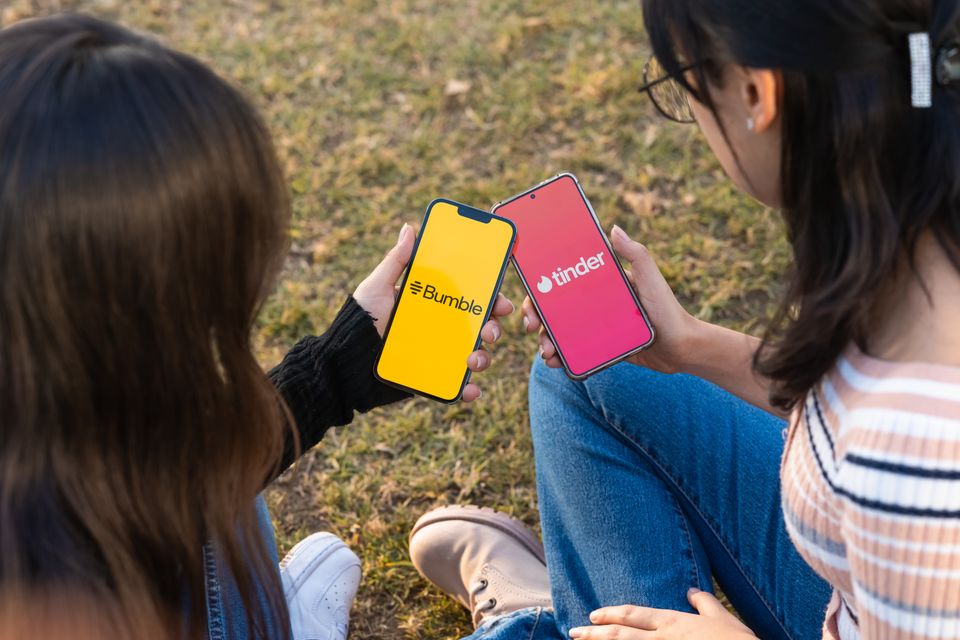
How do Hinge and Bumble compare?
The biggest difference is how you start. On Hinge you like or comment on a particular photo or prompt. On Bumble you swipe, match, and then someone has to send a first message.
| Hinge | Bumble | |
|---|---|---|
| How you show interest | Like or comment on a specific photo or prompt | Swipe right; message after a match |
| Who messages first | Either person | Either person (since August 2026) |
| Profile | Photos plus three written prompts | Photos, a short bio and optional prompts |
| Momentum, Q2 2026 | Revenue up 22%, monthly users up 13% | App revenue down 14.7%, paying users 2.08M (2.50M a year earlier) |
| Share of US online daters who’ve used it (Pew, 2022) | About one in five | 28% |
| Free version | Yes, with limits | Yes, with limits |
| Best for | Men who can write and want something serious | Men in cities where Bumble is busy |
The usage figures come from a 2022 Pew survey of 6,034 US adults: 46% of online daters had used Tinder, 28% Bumble and about a fifth Hinge. Those are lifetime numbers from before Hinge’s recent growth, so treat them as a floor for Hinge, not a ceiling.
Which app has more momentum in 2026?
Hinge, by a wide margin. In its second-quarter 2026 results, Match Group reported that Hinge grew revenue 22% year over year, with global monthly users up 13%, and it still expects Hinge to reach $1 billion in revenue in 2027.
Bumble is shrinking. Bumble Inc. reported that in the same quarter Bumble app revenue fell 14.7% to $171.7 million and Bumble app paying users fell to about 2.08 million, down from 2.50 million a year earlier.
Why does this matter to you? Growth isn’t a perfect proxy for your local odds, but it’s the best public signal there is. A growing app has more new profiles each week, and more of the people on it are actively using it. A shrinking one can still be busy in some cities, but the trend tilts the odds toward Hinge.
What changed on Bumble in 2026?
Bumble dropped the rule it was built on. Since 2014, women had to send the first message in heterosexual matches. In August 2026 the company opened it up so all users can send that first message, citing a survey in which 66% of women said they preferred men to message first.
For men, that cuts both ways. You no longer wait for her to start, so you control more of your results. But Bumble’s old selling point for men, that she had already chosen to talk to you, is gone. A match on Bumble now asks the same thing of you as a match on Tinder: a good first message.

Which app suits your profile?
Hinge suits you if you can write a little and you’re looking for something serious. Prompts give your words weight: in research on online dating profiles, photos predicted attractiveness most strongly, but the free-text part also played an important role. Hinge puts that text front and center.
Bumble suits you if your photos are your strength and Bumble is busy locally. A swipe app is decided mostly by the first photo, so a great photo set carries more weight there.
Either way, effort pays off more for men than for women. A study of Tinder behavior found that women gathered matches quickly while men gathered them slowly, and that a little effort grooming a profile went a long way, especially for male users. That applies on both apps.
How do openers differ?
On Hinge, your opener is the comment you send with your like. It should pick up what she wrote: “Portugal twice in one year? Which city won?” On Bumble, your opener comes after the match and works like a Tinder first message: something specific from her profile plus one easy question.
The research on what works is the same for both. In speed-dating data, people who asked more questions, especially follow-ups, were liked more and got more second dates. A specific question beats a clever line on any app. Compare “hey, how’s your week?” with “You can’t mention a night train in Vietnam and not explain.” The first could go to anyone; the second could only go to her, and that’s why it gets answered.
Aim matters too. On dating sites, people tend to message partners about 25% more desirable than themselves, and reply rates drop as the gap widens. Like and message women you’d genuinely enjoy dating, not only the top of the stack.
What makes a strong profile on either app?
The same three things, in the same order: a clear first photo, a varied photo set and specific words. Lead with your face in daylight, smiling, with no sunglasses or group. Follow with a full-body shot, a photo of you doing something you actually do, and one with friends where you’re easy to find.
Then write like a person, not a brochure. On Hinge, each prompt answer should hold one real detail she could ask about: a dish you cook, a trail you hike, a band you saw. On Bumble, a two-line bio with the same kind of detail does the job. Cut every cliché (“love to laugh,” “work hard, play hard”) and every rule (“no drama”). Rules read as bitter even when you mean well.
Finally, be honest about the basics. Height, age and recent photos all come out on the first date, and a mismatch there starts the evening on the wrong foot. A believable profile that gets fewer likes beats a polished one that disappoints in person.
Who should skip Hinge?
Men in small towns where Hinge is quiet, and men who genuinely want something casual. If you open Hinge and see the same handful of profiles every day, your pool is too small for its format to help. In that case, the app with the most local users wins, which is often Tinder and sometimes Bumble.
The same goes if you’re not looking for anything serious. Hinge’s culture leans toward relationships, and saying you want something casual there tends to cost you matches. Be honest about what you want on whichever app you choose; it saves both of you time.
Should you pay for either one?
Not until the free version is working. If your free profile gets matches and conversations, paying can save time. If it doesn’t, paying mostly shows a weak profile to more people. Prices vary by age, location and plan length, so check inside the app rather than trusting a number online.
The Pew survey found that 35% of online daters had paid for a dating platform at some point, so paying is common, not required. Fix your first photo and your prompts first; they cost nothing.
How should you use both?
Make one your main app and give it a real try. Build a strong Hinge profile, use it most days for a month, and move good chats to dates within a few days. Once that’s working, add Bumble with the same photos and a short version of your prompts.
Keep apps as one channel among several. Even with online meeting now common, most partnered people met some other way. Pair your app with a weekly activity: the where to meet women finder suggests one that suits you.
What's the final call?
Start on Hinge. Pick your prompts with the Hinge prompt picker, then run them through the Hinge profile review. If matches stay low, the match diagnosis finds the bottleneck. Weighing Tinder too? Read Hinge vs Tinder and Tinder vs Bumble.
Questions men ask
Is Hinge or Bumble better for men?
For a relationship, Hinge usually. Its format rewards a thoughtful profile and specific openers, and its user base is growing. Bumble can still work well in cities where it’s busy.
Can men message first on Bumble now?
Yes. In August 2026 Bumble dropped its women-first rule, so either person can send the first message after a match.
Should I use Hinge and Bumble at the same time?
You can, but keep one as your main app. Two half-maintained profiles do worse than one strong one. Add the second once the first is working.
Is it worth paying for Hinge or Bumble?
Only after your free profile gets matches. Paying to show a weak profile to more people rarely fixes anything. Prices vary by age and location, so check the app.